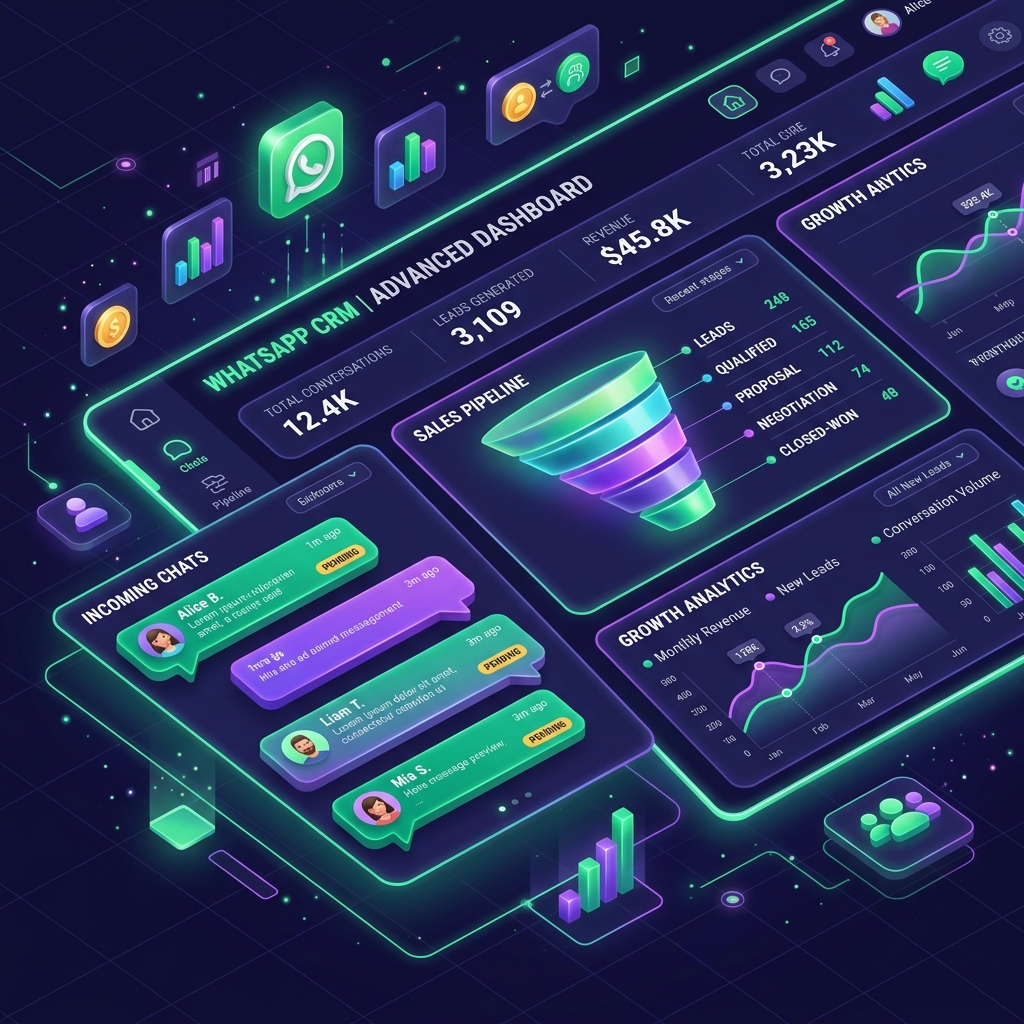
Most WhatsApp CRM comparisons in India start at the wrong place. They compare message sending, inboxes, and campaign buttons, but the real buying question is what happens before and after the WhatsApp message.
A value-for-money WhatsApp CRM should capture the lead, show the pipeline, trigger the right WhatsApp template, send supporting email, schedule AI calling when useful, and make the next action visible to the team without forcing five separate subscriptions.
Compare the complete revenue workflow
A WhatsApp CRM should not be judged only by whether it can send an approved template. The better test is whether the system connects the full workflow from first touch to qualified opportunity.
For KelBrix, that journey can start from a digital card, move into CRM and pipeline, continue through WhatsApp Business API templates, and then branch into email, AI calling, reminders, and automations.
- Lead capture from digital card, QR, forms, imports, and manual entry
- Pipeline stages for new, contacted, qualified, won, and lost leads
- WhatsApp Business API templates linked to the right stage
- Email and AI calling connected to the same customer context
- Clear reports so a non-technical owner can see what happened
The strongest Indian buying use case is missed follow-up
Many Indian SMEs do not lose revenue because the first enquiry never came. They lose it because the first response was slow, the second follow-up was forgotten, or the business owner could not see whether the team replied.
That is why a practical WhatsApp CRM should make the next action obvious. The product should tell users who is waiting, which stage they are in, and which message, email, or call is due next.
Use WhatsApp API templates safely, but do not make users plan everything
Approved WhatsApp Business API templates are necessary for automation, but non-technical users should not have to map every variable manually. A better product pulls approved templates, suggests missing stage-specific templates, and fills common variables from the lead and company profile.
For buyers, this means checking whether the system can guide template setup for new leads, contacted leads, qualified leads, won customers, and lost reactivation instead of leaving the admin to guess.
Compare KelBrix against WhatsApp-first tools and CRM-first tools
WhatsApp-first tools can be strong for inbox and broadcast operations. CRM-first tools can be strong for sales administration. KelBrix is designed for teams that want the middle path: WhatsApp-first selling with CRM, digital card capture, email, AI calling, and automations inside one working stack.
If you are comparing WhatsApp tools, review KelBrix vs WATI and KelBrix vs Interakt. If you are comparing broader CRM tools, review KelBrix vs Zoho CRM and KelBrix vs HubSpot.
The value-for-money rule
The best value is not the cheapest plan. The best value is the plan that removes the most operational leakage while keeping usage costs honest. If WhatsApp API, email, AI calling, and telephony are billed by the provider wallet, the software subscription can stay focused on workflow and team productivity.
That model is easier to understand, easier to resell, and safer for scale because heavy usage does not silently destroy margin.
Frequently Asked Questions
What is the best WhatsApp CRM for value-for-money teams in India?
The best fit is usually the tool that covers the full lead-to-follow-up journey, not only WhatsApp sending. Buyers should compare lead capture, CRM visibility, WhatsApp Business API readiness, email, AI calling, automation, and whether provider usage is billed directly without hidden markups.
Should a business choose a WhatsApp marketing tool or a CRM first?
If the team only needs broadcasts, a WhatsApp marketing tool can work. If the team needs to capture, qualify, follow up, call, email, and track leads, a WhatsApp-first CRM is the stronger long-term choice.
Why does provider-owned billing matter?
Provider-owned billing keeps WhatsApp API, email, AI calling, and telephony usage transparent. The software fee pays for workflow, CRM, automation, and team productivity instead of hiding usage inside inflated platform bundles.
Share this article